
Lesson Plan 4
Secondary research for rationale and hypothesis
- Objective:
- Students understand the NEED for secondary research
- Students differentiate between secondary and primary research.
- Students conduct secondary research for their own RQs.
- Resources:
- CaL Note Book
- Pencil/Pen
- Blackboard + Chalk
- 1 Computer with Internet access connected to a projector
- Graphic Organisers
- Time 2 Periods (45 min each)
- Plan:
- Period 1
Step 1. Whole Class Instruction (20 min): Students sit in their CaL groups with the RQ approved by the teacher. The teacher explains:
“Secondary data in research is data already collected by someone else while primary data is data collected by yourself e.g., if you do a survey or personal interview and you use the data for your research then its called primary data. But, if you use the data collected during the census, or a book/magazine, or even an online article then the data is called secondary data.
Why do we need to collect secondary research data for CaL? This is important to understand. When someone reads your final CaL paper, they should understand that your RQ is important for our city and you have to convince them by writing a rationale. We will see how to write a rationale next time but today’s secondary research lesson will help you write that rationale next time. This secondary research will also be helpful in framing your hypothesis.
As I said, If you collect data and use it for your own research it becomes primary data but if you are using data collected by someone else then its called secondary data.
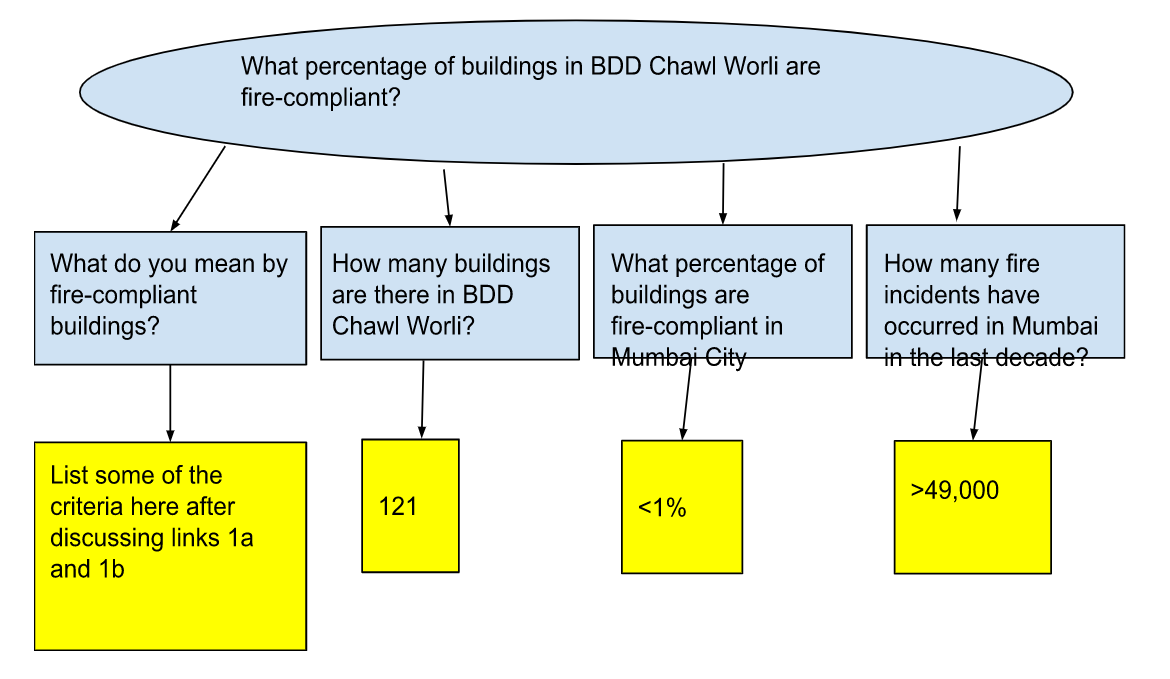
Let’s take an example RQ – What percentage of buildings in BDD Chawl Worli are fire-compliant? Let us think of sub-questions connected to this RQ that you can do secondary research on –
- What do you mean by fire-complaint buildings?
- How many buildings are there in BDD Chawl Worli?
- What percentage of buildings are fire-complaint in Mumbai city?
- How many fire incidents have occurred in Mumbai in the last decade?
Now let us understand the difference between primary and secondary research for these questions:
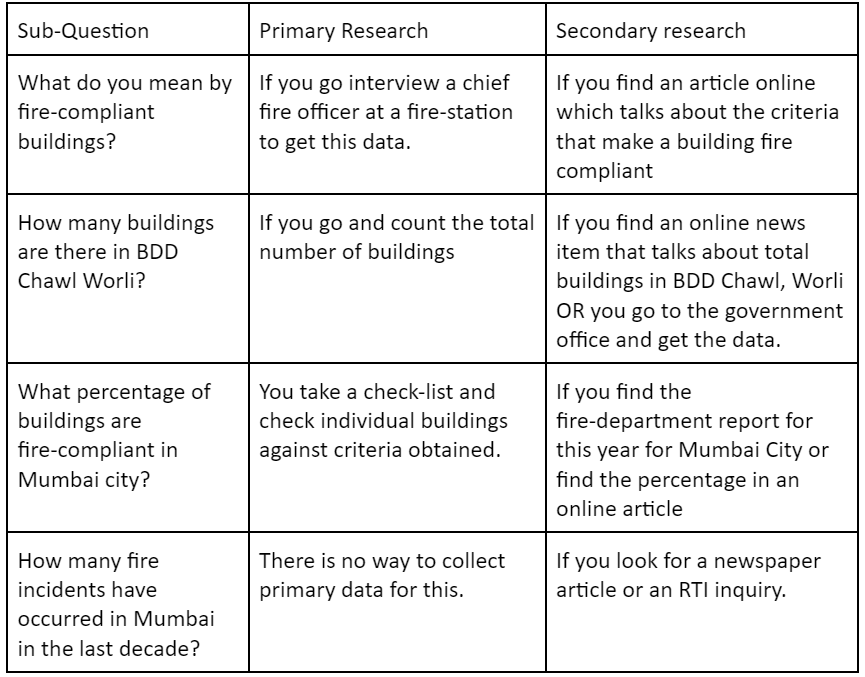
Today we will learn how to find relevant secondary data for your sub questions using the Internet. This secondary data will help you understand how your RQ is relevant to the city or community you live in.
Step 2. Secondary Research Modelling: (25 min) The teacher draws the following graphic organizer on the board and fills the RQ and the three sub-questions. Now, using a wi-fii enabled computer connected to the projector, the teacher models how to do a Google search for each of the questions. After doing a few Google searches to teach children how to search using keywords, the teacher opens the three links provided below one by one. As she opens each link, she discusses with the class, which sub-question each link helps us answer. She reads through the information in each link with the kids and fills out the last 9yellow) boxes of the graphic organizer on the board. Remind students to save any links they use for secondary research on a word doc or email the links to themselves.
TEACHERS PLEASE NOTE:
Our secondary research revealed that in Mumbai city, less than 1% of buildings are fire compliant. Students may consider this information when formulating their own hypothesis about buildings in BDD chawl. They may hypothesize that similar to the rest of Mumbai, less than 1% of the 121 buildings in BDD chawl are fire compliant or they may hypothesize based on their own experience of living there that at least 10% of the BDD chawl buildings are fire complaint. The point is that the secondary research points students in a particular direction of thinking when creating the hypothesis so that the hypothesis is not completely random.
Step 3. Mini-brainstorm: (10 mins) Students now do a mini-brainstorm in their groups to generate sub questions that they can collect secondary data on. Remind them that the PURPOSE of doing the secondary research is to build a strong case for WHY the research question is important. SO the sub questions they ask should be such that they relate their RQ to the larger context of the city. The teacher should help them out here.
- Period 2
Step 4. (45 min)Students either meet offline or in the next class to complete their secondary research AFTER teacher approves their sub questions. They fill in the graphic organizer shown above for their own RQ. The purpose of doing secondary research is to be able to write the rationale (next lesson) so this is an important step.
Remind students to save any links they use for secondary research on a word doc or email the links to themselves.