Lesson Plan 9
Data collection methods Intro
- Objective:
- Students understand what data means
- Students understand different methods of data collection
- Resources:
- CaL Note Book
- Pencil/Pen
- Blackboard + Chalk
- A printout of the quiz attached per student OR a chart with the quiz questions
- A magnet
- Access to other classrooms
- Drawing paper and art stationary
- Blue tac
- Print-outs of the group tasks
- Data Collection PPT (Provided by CaL)
- Last ten years’ 10th standard results of the school (if this is not available, you can make something up)
- Time: 2 Periods (45 min each)
- Plan:
Prep Needed::
Please inform other teachers, classrooms that your students will come in to conduct some surveys, etc
- Period 1
The information we need to collect to answer our research question is called Data. We have looked at the difference between primary and secondary data. Today we will look at data collection and data collection methods.
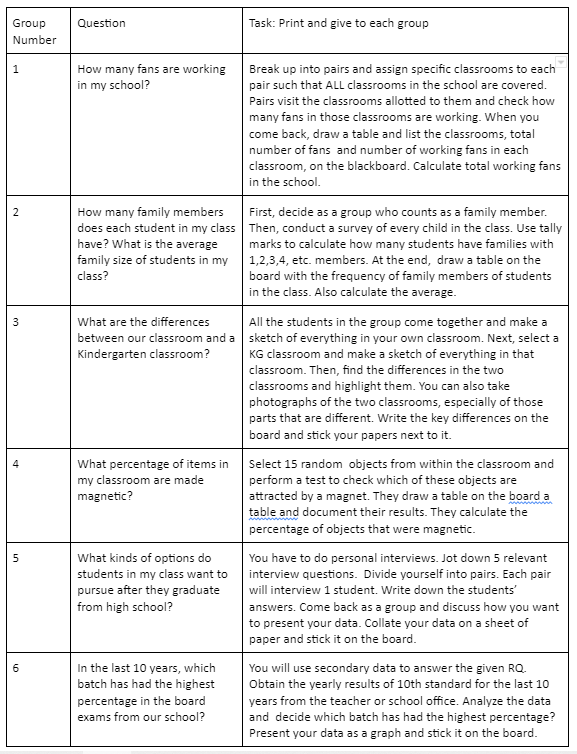
Step 2. Group Activity (33 mins): Break the class into six groups. Each group gets a research question for which they need to collect data. Aligned with their RQ is a task that the group has to complete. Take 10 minutes to give instructions, make the groups and hand out the required information. Students have 15 minutes to complete the task and 5 minutes to record their data on the board.
Step 3. Whole class instruction (10 min): The teacher asks each group to explain what method of data collection they used and information they found.
- Period 1
Step 4. Whole Class instruction (30 min): Teacher reminds students of the activity they did last time. She discusses with the class and lists the different methods used by each group to collect data: observational survey, survey, observation, test, interview, secondary data. Teacher explains:
Each team used a different method to complete your data collection. The method that you use for data collection is called the data collection method and the means that you use to do this data collection is called the data collection tool. For example, the data collection method for team 4 was an interview and the tool was the actual questions you asked. For team 3, the method was observation but the tool used was sketching. Team 1 also conducted observations but they used a different tool – a table.
Teacher presents and explains each of the following types of methods using the PPT:
- Observation: Data that require you to use your eyes to see and record something are best collected through observation. Anything that needs to be described (e.g., how safe a play area is) or anything that changes over time (e.g., how Mumbai’s green cover has reduced over the last 20 years) should be recorded using observation as a data collection method. You can use tally marks, sketches, photos, written descriptions, etc. as your TOOLS for observation. Group 1 used observation for data collection.
- Photos or sketches: are usually tools which are used to capture data collected through observation. We have included this as a separate category to encourage inclusion of photos or sketches where possible. Group 3 used observation as their data collection method. Their TOOL was sketches.
- Survey: A survey is a way of collecting feedback for a set of questions with easy or simple choices for people to fill out. Group 2 used survey for data collection. When you want NUMERICAL data (percentage or ratio) then a survey is a good tool to collect data. The actual survey you use, the questions that make up the survey, etc. forms the TOOL. Your survey questions can be Yes/no, MCQ, a rating scale or 1-2 word responses.
- Interviews:
-
- Personal Interviews: if you would like detailed information about a topic or if your audience cannot fill out a survey for you, then you can use personal interviews for data collection. Group 5 used personal interviews for data collection.
- Expert Interviews: Interview is a good method to use when you want to include “expert” voices in your research. The actual interview questionnaire with your selection of questions becomes the TOOL.
- Experiment: When you conduct any type of scientific or social experiment to collect your data then this method should be included in your list of data collection methods. E.g., if a group of students want to know how polluted the water from the Mithi river is then they can collect water samples and do experiments. Group 4 used an experiment as their data collection method. The TOOL in this method is the actual experiment, all the apparatus you use and the procedure you follow.
- This is a kind of experiment in which you can have a pre-experiment and post-experiment test. Sometimes the pre- and post-tests can be a survey or personal interview; so this method combines two methods. For example, you may want to conduct an experiment to see what happens to student attention spans if they miss lunch. You can do a pre-lunch test and a post-lunch test to collect this data.
- Secondary data: When your research question requires data collected over many years and you borrow the data from a secondary source, this data collection method is used. The 6th group used this method.
To answer a research question rigorously consider using multiple data collection methods. Your choice of data collection method is crucial for you to answer the RQ.
The teacher writes the following RQs on the board and asks a few students to answer which data collection method would best in each case and why

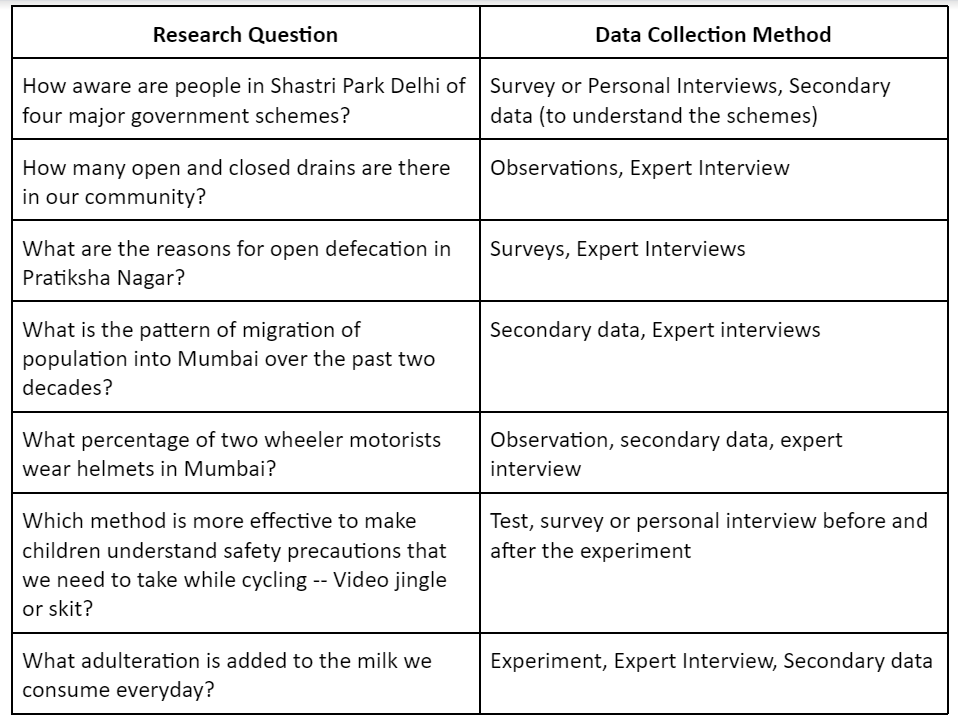
Step 5. Group Quiz (15 mins): Provide the following research questions to every group of 4 students and ask them to think about which data collection methods would be applicable for each question and WHY. Give students 5 minutes to complete the quiz. Discuss every question with the whole class. Focus on WHY the chosen methods are relevant, why multiple methods are better than one and why other methods may not work.