
Lesson Plan 6
Writing hypothesis for their groups
- Objective:
Student groups write a hypothesis for their RQ.
- Resources:
- CaL Note Book
- Pencil/Pen
- Blackboard + Chalk
- Time: 45 min
- Plan:
Step 1. Whole Class Instruction (15 min):
Teacher explains what a hypothesis is – A hypothesis is not just a guess or a prediction but rather it is an EDUCATED prediction based on prior knowledge and secondary data researched.
Suppose the research question is: Which is the hottest part of Mumbai city? She writes this question on the board. She asks some students what their guess is and WHY? The why is very important. Students may say different parts of the city based on prior experiences. Based on student responses, let us assume the teacher picks one of the responses that states “Our hypothesis is that Andheri is the hottest part of Mumbai because there are very few trees there and lots of autos.” (This may change on what responses the class gives). This is a hypothesis.
Teacher can choose to do another example but ensure that when she writes the hypothesis on the board, she includes the words OUR HYPOTHESIS IS ….. BECAUSE.
The second criterion for a hypothesis is that it all parts of it should be TESTABLE. You should be able to test it. If you cannot test it, it’s not a good hypothesis. In the example above, we can actually test if Andheri is the hottest area in Mumbai by measuring the temperatures across areas for a few days or looking at long term secondary data. In order to test if this is because of the lack of trees and too many autos, students MUST collect data in areas with and without autos and with and without many trees.
So the data collection is actually guided by the hypothesis. Students need to think carefully about their hypothesis as THAT is what they will test.
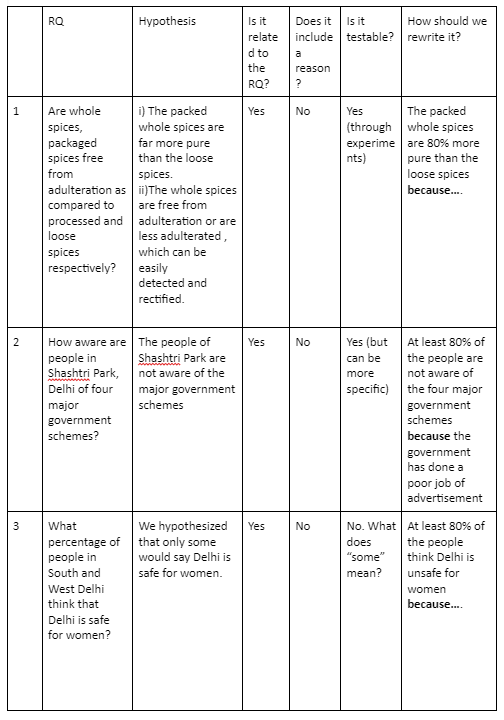
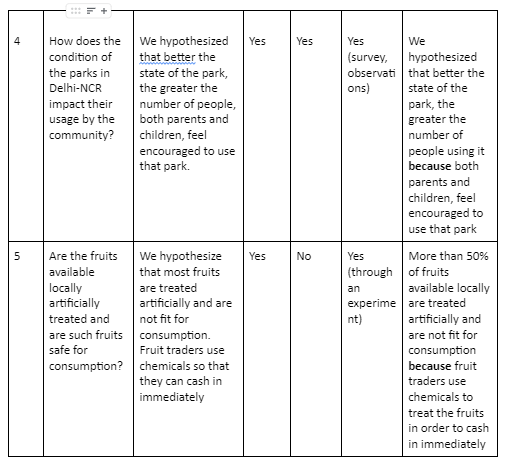
Step 2. Small Group Activity (15 min): In small groups, teacher gives students 5 RQs and 5 hypotheses. Students match the RQ with the hypothesis. Teacher checks if their matching is correct. Then they go through each hypothesis and evaluate whether it meets the three criteria:
- It is related to the RQ
- It includes a REASON
- All parts of it are testable
Step 3. Group Activity (10 min): In project groups, students come up with their own hypotheses for their RQ. Teacher walks around and helps them think through it. Students can take this offline and submit their hypothesis to their teacher over the next few days. Hypothesis must meet the three criteria.